Same. Difference.
Dissecting the (un)competitive market positioning and language of leading UK construction and engineering consultancies.
An independent audit of 75 firms. Scored across seven dimensions. April 2026.

Engineering and construction consultants: Market positioning and messaging
![Donut chart showing the distribution of positioning formulas across 75 firms. The dominant formula – "to [verb] a [better/sustainable] [world/future] for [people/communities/our planet]" – accounts for around a third of the dataset, with smaller segments for variations on the same theme.](https://cdn.prod.website-files.com/6967a46d5e14b70945dac929/69de0777b9999b810319072a_Artboard%201%402x.png)
Firms claim the same market positioning (what sets them apart from competitors) the same values, the same language.
Effectively, you could remove the logo from most firms’ About pages and be unable to identify the firm.
We measured it across 75 firms, using a methodology that scores market positioning, values architecture and distinctive brand voice across seven dimensions.
This is what we found.
[Left] Donut chart showing the distribution of positioning formulas across 75 firms. The dominant formula – "to [verb] a [better/sustainable] [world/future] for [people/communities/our planet]" – accounts for around a third of the dataset, with smaller segments for variations on the same theme.
The findings
This is not a study of firms that have neglected their brands. Several have invested significantly – commissioning internationally recognised design agencies, producing visual identities of genuine quality.
The convergence here runs deeper than neglect. And deeper than investment, it’s structural.
Market positioning is a distillation of a firm’s reputation. It tells the people who don’t know you yet why they should choose you – and confirms to those who do that their confidence is well placed. It’s how reputation travels beyond the relationships that built it. For most firms in this study, that mechanism is not working.
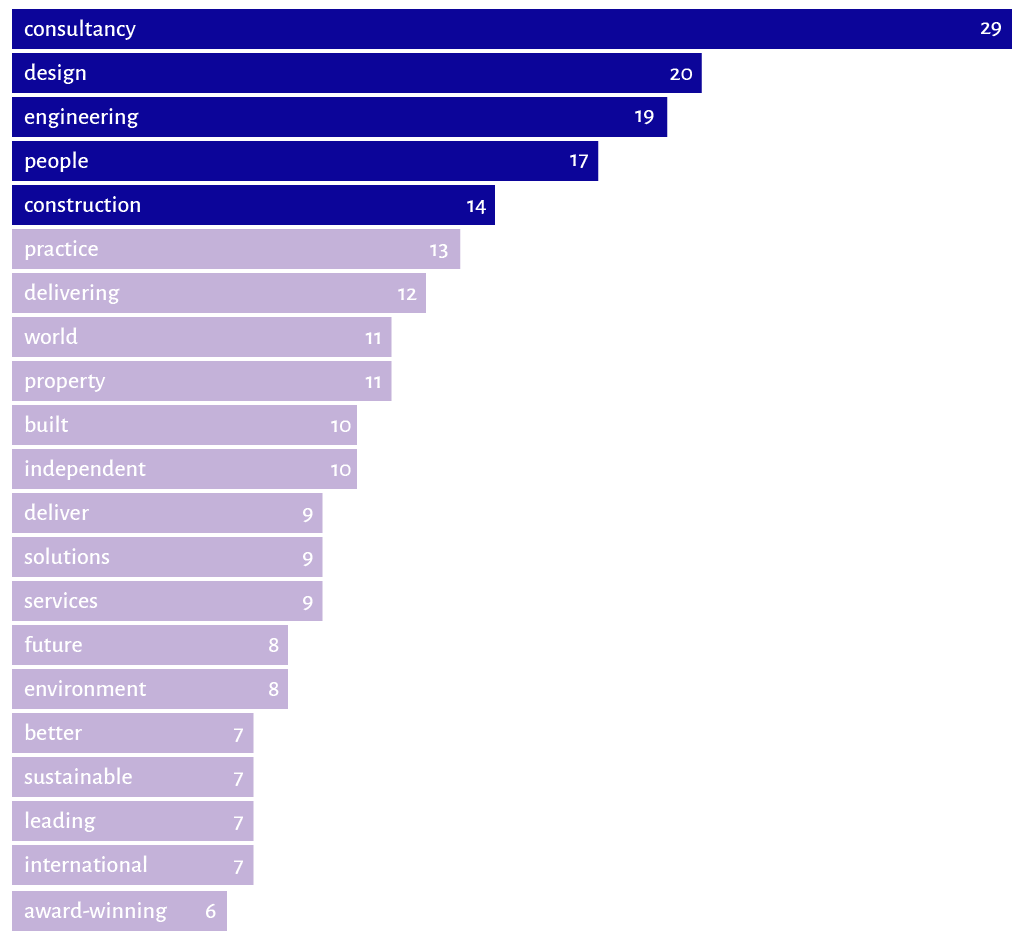
Strip out the firm names and positioning statements become difficult to tell apart. ‘Consultancy’ appears 29 times across positioning text. ‘Engineering’ 27 times. ‘Delivering’ 13 times. ‘Solutions’ eight. The sector is effectively writing the same sentence with minor variations.
In purpose statements, the convergence is sharper still. The dominant formula reads:
‘To [engineer/shape/improve] a [better/sustainable] [world/future/society] for [people/communities/our planet].’
A third of firms share this substantially similar purpose. Nine firms use some variation of ‘[verb]-ing a better [world/future/tomorrow]’ as their primary positioning line.
A positioning that is true of everyone distinguishes no one. The problem is not the territory. It’s what happens when a whole sector occupies it at the same time.
[Left] Donut chart showing the distribution of positioning formulas across 75 firms. The dominant formula – "to [verb] a [better/sustainable] [world/future] for [people/communities/our planet]" – accounts for around a third of the dataset, with smaller segments for variations on the same theme.
What the data shows
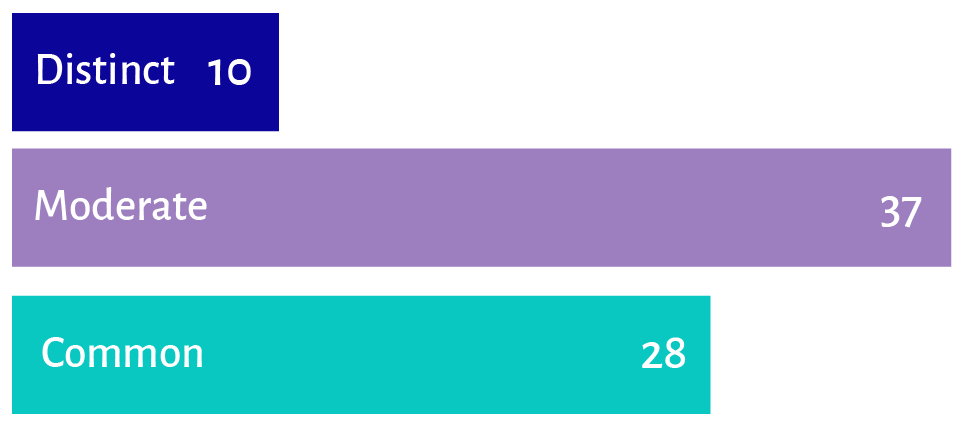
We rated each firm’s market positioning statements as Distinct, Moderate or Common – using a name-swap test. Could this copy appear on a competitor’s website without anyone noticing? Genuinely distinctive positioning (that couldn’t be transplanted to a competitor) rates Distinct. Generic or interchangeable language rates Common.
On values, the picture is no better.
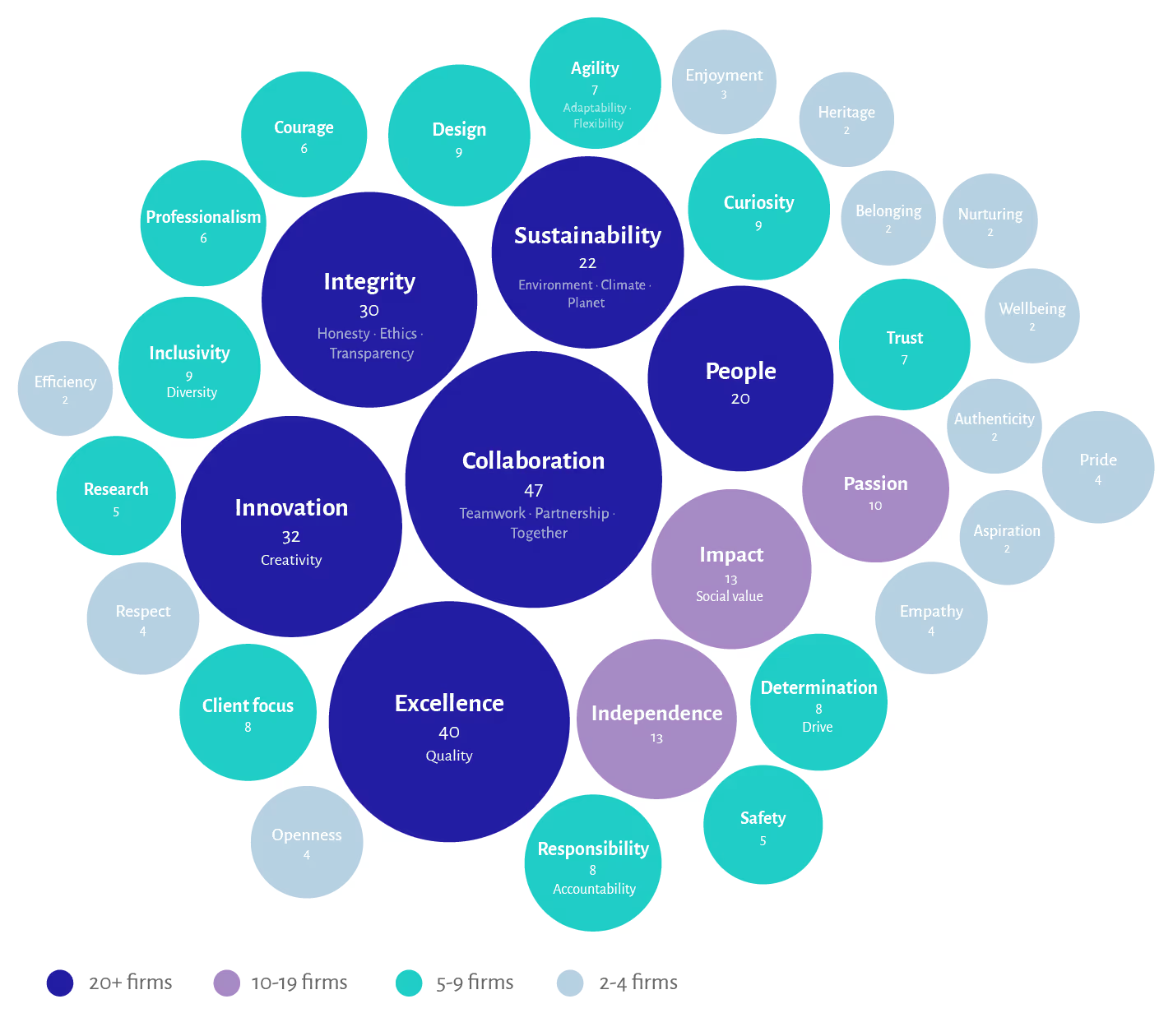
Five value territories dominate across the dataset: Collaboration, claimed by 64% of firms. Excellence by 53%. Innovation by 43%. Integrity by 40%. Ninety-five per cent of firms claim at least one of these. These are not differentiators. They’re table stakes.
The sector’s investment in positioning and language produces a genuinely distinctive outcome for barely one in seven firms.
Market positioning differentiator ratings across 75 firms: ten firms rated Distinct (dark blue), 37 rated Moderate (purple), 28 rated Common (cyan). Common and Moderate together account for four in five firms.
Brand voice radar: Sector's average score across seven brand voice dimensions: language clarity, active voice, directness, concrete language, human register, outward/client focus and ownable language. The shape is strong on active voice and directness but collapses inward on outward/client focus and ownable language – the dimensions most associated with distinctive writing. (Click to enlarge)

All 75 firms by composite Brand Voice Radar score, Bars are coloured by differentiator rating, showing that strong voice scores cluster in the Distinct group but a high score for brand voice distinctiveness does not always correlate to a distinctive positioning. (click to enlarge_

Brand voice – where the gap opens
We scored all 75 firms across seven voice dimensions: language clarity, active voice, directness, concrete language, human register, outward/client focus, and ownable language. The sector mean composite score is 55.3. The spread runs from 37.4 to 77.0.
The sector generally writes in active sentences. Active voice and directness are strong across the board. But the shape collapses inward on the dimensions that matter most.
Outward/client focus – the balance between talking about yourself and talking to your reader – is the sector’s weakest score by a wide margin. Nine firms score zero. Their About pages never once address the reader or frame their services in terms of a client’s benefit. Nearly a third of firms are talking exclusively about themselves.
Ownable language follows as the second critical gap. Only 15 of 75 firms score above 5.0. The remainder write in a way that could be any competitor’s words.
The irony: the very firms making the most ambitious claims – purpose-led, sustainability-forward, shaping a better world – tend to produce the least distinctive writing. Purpose-led positioning, when it stays generic, produces generic language. The ambition of the claim and the quality of the writing pull in opposite directions.
Values – the Enron test
Famously, Enron’s published values were Respect, Integrity, Communication and Excellence – four words that could have belonged to any company and, as it turned out, meant little to Enron. One of the most spectacular corporate failures in recent memory had values indistinguishable from those of the most reputable firms in any sector.
The same pattern runs through this dataset. Five value territories dominate: Collaboration. Excellence. Innovation. Integrity. Ninety-five per cent of firms claim at least on. They are not differentiators. They’re table stakes.
There’s a meaningful distinction between a single-word label, ‘Integrity’, and a behavioural statement – ‘We tell clients what they need to hear, not what they want to hear.’ More prescriptive, more memorable, harder to ignore. It also describes how it feels to work with the firm, which is what clients are actually buying. Firms with abstract-only values score weakest on our differentiator rating.
Most telling: 59% of firms appear to present different versions of their values in different places. On their website, their careers page, their annual report. If the organisation can’t be clear what it stands for, nobody will.
Frequency of 'values' words claimed across 75 UK construction and engineering consultancies. Bubble size is proportional to the number of firms claiming each territory. The five dominant values – Collaboration (47 firms), Excellence (40), Innovation (32), Integrity (30) and Sustainability (22) – dwarf the remainder. Smaller bubbles represent less common values including Curiosity, Joy, Empathy and Enjoyment – territories where genuine differentiation is more likely to be found. (Click to enlarge image)
Blanding – Behind the convergence
The convergence isn’t carelessness.
Understanding why requires looking at the structures that produce brand strategy, not just the outputs.
Strategy processes – particularly run at scale, across multiple geographies and service lines – are designed to build internal alignment. Language that survives a roomful of stakeholders may to be the language nobody objects to: abstract, aspirational, inclusive. Almost by definition, it is language that others are using too. A differentiated position requires committing to something that someone, somewhere, might disagree with. While buy-in is critical, concensus-built strategy rarely gets there.
A purpose problem
The shift toward purpose-led positioning is partly an attempt to make an emotional connection with clients and talent, and the instinct is right.
People do not choose between technically comparable firms on a spreadsheet. They choose the one that feels right. The trouble is that the sector has reached for the same emotional territory at the same time – and when everyone is engineering a better world, the emotional positioning becomes as crowded as the rational positioning it was meant to replace.
It is a culture question before it is a language question. Your competitors can battle you on fees and credentials. They cannot replicate what makes you you – the specific value you deliver to clients and the conviction that drives it. Most firms in this study haven’t yet done the work to find out what that is.
For a growing number of firms, the purpose statement has quietly taken over the role of the positioning. The two are not the same thing. A purpose explains why you exist. A positioning explains why someone should choose you over the competitor. When one substitutes for the other, you get language that is sincere and aspirational – but not differentiating.
A branding paradox
Several firms in this study have undergone high-profile rebrands led by internationally recognised agencies. The results are visually impressive.
Yet this group’s mean voice score is 49.7 – below the sector average of 55.3. Behind polished visual systems, the verbal identity is indistinguishable from the sector at large.
The ten firms rated for positioning as ‘Distinct’, by contrast, show no evidence of involvement from large brand agencies. Their distinctiveness appears to come from internal clarity – a conviction about how they work and what they believe that finds its way into language.
This is not an argument against agencies. If you could match the visual quality of an agency-rebranded firm with equally distinctive positioning and messaging, the result would be a powerful competitive force. But distinctive positioning tends to originate not in one morning’s workshop, but in gaining a genuine understanding of what a firm does differently – and why that matters to clients.
The exceptions
Ten firms – around one in eight – stand out for saying something genuinely distinctive. What links them is not size, specialism or agency involvement. It is a willingness to say something specific enough to fail the name-swap test.
Three quarters of firms fail that test outright. For barely one in seven does the positioning achieve something genuinely distinctive – not just different in wording, but impossible to mistake for anyone else.
They achieve it in different ways. Some through positioning specific enough to be unmistakably their own – AHMM’s ‘Economy; Elegance; Delight’ could only belong to an architecture practice. RLB’s ‘Where People Make Progress’ carries layered meaning that compounds on re-reading. Robert Bird Group’s ‘Specialists in a world of generalists’ is a direct challenge to the sector’s full-service orthodoxy.
Some through proprietary methodology – a description of how the firm thinks, not just what it does. Elliott Wood’s ‘Reveal; Materialise; Impact’ implies a philosophy of uncovering latent potential rather than simply executing a brief. BB7’s ‘Creators of safe spaces’ anchors a fire safety consultancy in language that is both ownable and human.
Some through the specificity of their values – Ramboll’s set of Empathy, Insight and Enjoyment deliberately avoids the sector’s standard vocabulary. ‘Enjoyment’ is almost unheard of as a corporate value in B2B professional services. It is all the more distinctive for it.
What these firms share is the discipline of saying something concrete, and the willingness to say something that not everyone will agree with. The weaker positioning lines assert a quality without anchoring it in what the firm actually does. The stronger ones could not be transplanted to a competitor without feeling wrong.
The 10 firms rated Distinct for their positioning or methodology, ranked here by their composite voice score: The dashed line marks the sector mean of 55.3.

What it costs
Most of the firms in this study are not struggling. They are busy winning work, retaining clients, recruiting people. The convergence documented here is not a crisis.
But it is a ceiling.
When a prospective client reads three firms’ About pages and cannot tell them apart, the decision defaults to price, proximity, or personal relationships. The commercial consequences run further than that single moment.
Distinctive brands command better fees – price becomes one factor among several rather than the deciding one. They attract better talent: this sector competes for the same engineers, surveyors and technical professionals across the same firms, and generic employer language gives a candidate no real reason to choose you over the firm next door offering the same salary. And clear positioning pays its way in the pitch process – when your brand is doing its job, you arrive already differentiated. When it is not, every credentials presentation starts from zero. Every proposal has to establish a position your brand should have built already. That is business development time and cost that distinctive firms are not spending.
Too often, branding is treated as a one-and-done exercise – a project with a start and end date, guidelines produced, website launched, everyone moves on. Brand is not a project. It is a practice – an everyday activity that lives in every proposal, every conversation with a client, the job of everyone who speaks on behalf of the firm.
A brand strategy that begins and ends with purpose is a building with one wall. A distinctive look without a distinctive voice is half a brand. A purpose without a positioning is half the proposition. The sector has invested in the visible, deliverable parts of branding while leaving the harder, ongoing work of brand undone.
A territory nobody has claimed
Across all 75 firms in this study, not one makes AI or machine learning a central part of its messaging.
Legal services, accounting and management consulting have all begun to position AI-augmentation as a client-facing differentiator. Construction and engineering consultancies, by contrast, have little specific to say on the subject.
Nobody is telling clients that AI changes how they deliver, what they can predict, or why their advice is sharper for it.
The gap is not in capability. AI-augmented design, energy modelling, cost forecasting and programme management are already in use across the sector. The gap is in positioning. The first firm to articulate a credible, specific AI proposition – not ‘we use technology’ but ‘here is what it means for your projects’ – would occupy unmapped territory. Though if other sectors are any guide, that window will be brief. AI will follow the same path as sustainability – from differentiator to table stakes faster than most firms will move. The firms best placed to claim it, and to hold any position beyond it, are the ones that have already done the harder work: understanding what they specifically deliver, and building a brand distinctive enough to make any claim credible.
Mind the gap
The gap this study documents is a real one. It’s also – for firms prepared to do the hard work – the most open positioning opportunity in the sector .
Same. Difference. Get the report.
The complete study. Brand Voice Radar scores for all 75 firms. The market positioning map. The values architecture analysis. The methodology behind the findings. And the detail on ten firms that break the pattern – positioning moves, voice characteristics, and the principles that separate distinctive from generic.
Reading time: 20 minutes. Strategic value: longer.
Strategy. Clarity.
Brand is not a cost. It is a path to sustainable competitive advantage. Working for you, it differentiates you in a crowded market, aligns your people around a common purpose, and builds the kind of reputation that compounds over time – getting you on longlists, tipping decisions when technical scores are close, making clients pick up the phone to you rather than the firm next door.
That happens when insight, strategy and creative thinking work together.
The clarity to move forward.
To discuss, contact Garrett
Rights and usage.
© Garrett Reil 2026. All rights reserved.
The Brand Voice Radar scoring methodology, the differentiator rating framework and the analytical findings in this report are the intellectual property of Garrett Reil Brand Consultants.
The report may be quoted with attribution: ‘Same. Difference. – Garrett Reil, 2026’. For permission to reproduce charts, data tables or substantial extracts, contact garrettreil.com.
Brief extracts of firms’ published positioning copy, straplines and values statements are reproduced for the purposes of analysis, criticism and review under fair dealing provisions of the Copyright, Designs and Patents Act 1988. All firm names, straplines and brand assets remain the property of their respective owners.
No endorsement or affiliation is implied or claimed.