Is brand purpose a positioning tool?
Your ‘why’ – your brand purpose – is done. Strategy document, authentic, believable, signed off.
Someone asks: So, why should a customer choose us over the competition?
The purpose statement doesn’t quite answer that.
It wasn’t designed to.
So is purpose a positioning tool?
No. And yes. Sometimes.
Every organisation has a purpose
Before getting to that, one thing needs to be said. Every organisation has a purpose. A ‘purposeless’ organisation isn’t a thing – it’s just an organisation that hasn’t looked hard enough at why it does what it does.
The standard definition – why you exist beyond profit – carries an assumption that purpose needs to be elevated, even noble. Which is partly why it became so easy to conflate with social mission and brand activism. And it’s why some organisations view the whole conversation with suspicion. The language feels alien to people running engineering firms, logistics businesses, or B2B tech companies. It sounds like something that happens in other kinds of organisations.
Purpose doesn’t have to be highfalutin’ to be real.
‘We exist to make financial reporting less painful for mid-sized businesses’ is a legitimate purpose. So is ‘we fix X for Y’ or ‘we make it easier for A to do B.’ Functional statements of why an organisation exists are often more useful than elevated ones – specific enough to shape decisions, honest enough to earn belief.
The work of purpose isn’t invention. It’s excavation. The seed of purpose is already there. The question is whether it’s been found, named, and put to work.
The confusion starts (with why)
Simon Sinek’s Golden Circle made ‘why’ feel like the answer to every strategic question – internal and external simultaneously. Jim Stengel’s Grow study appeared to prove the commercial case. Consultants built practices around it. Purpose stopped being an organisational anchor and became a market-facing proposition by default.
The result: some brands were trying to win customers with answers to questions customers weren’t asking.
Unilever’s CEO named it precisely in 2023. The topics had been conflated and the business case had got confused. Five years of force-fitting purpose onto brands that didn’t need it had produced more heat than light.
Three-ish kinds of purpose – and what each one does
Not all purposes sit in the same relationship to positioning.
Functional purpose – ‘we fix X for Y,’ ‘we make it easier for A to do B’ – is already doing competitive work. It’s specific, verifiable, and points directly outward to the market. The line between this kind of purpose and a positioning statement is often short and direct. The purpose doesn’t just inform the positioning – in many cases it practically is the positioning, or the foundation of it.
Mission-driven purpose – where an organisational conviction is so deeply embedded in the product, the operation, and the way the business is run that customers encounter it through direct experience – can also earn competitive weight. But it requires embedding, not just declaration. The purpose has to be verifiable. Customers need to be able to find the evidence themselves, without being told where to look.
Unexamined purpose – present in an organisation, but never explicitly named or activated. It shapes behaviour and decisions below the surface, often inconsistently. The work here is excavation first: surface it, examine it, decide whether it’s the purpose you’d choose if you were choosing deliberately.
The no
For most organisations, most of the time, purpose and positioning are doing different jobs for different audiences.
Purpose is for your people. It shapes how decisions get made, what the organisation will and won’t do, what it stands for when no one is watching. Positioning is for your market. It answers the competitive question customers are actually asking when they’re choosing between you and someone else.
Conflating the two doesn’t strengthen either. At worst, it produces strategies that feel meaningful but say nothing distinctive – and creative work that inspires without converting. ‘We exist to make the world better’ is not a reason to choose you. It’s a reason to feel good about the company you’ve already chosen.
For most brands, most of the time: purpose is not a positioning tool.
The yes. Sometimes
But when purpose is functional, or when it’s mission-driven and deeply embedded, it can do competitive work. And when it can, communicating it externally isn’t just legitimate – it’s powerful.

An example everyone in this field reaches for – myself included, it lived in my slide decks for years – is Patagonia. Remember, ‘Don’t buy this jacket.’ Transferring ownership of the company to the planet. It’s a strategy built entirely around it. It works because every product decision, supply chain choice, and repair programme already demonstrates what the brand declares. Customers don’t just hear it; they can verify it.
A clear illustration is any charity I’ve worked with. A charity’s purpose is rarely abstract... ‘We’re here to help people and their families facing cancer.’ Stated in plain terms, known to everyone inside the organisation, immediately legible to everyone outside. There’s no gap between what the organisation is and what it claims. In many cases the purpose isn’t just connected to the positioning – it is the positioning. The internal and external collapse into one because the purpose is specific enough, and demonstrated clearly enough, that no translation is needed.
That’s the condition under which purpose earns the right to do competitive work. Not the strength of the conviction. Not the quality of the copywriting. The fact that it’s embedded deeply enough in what the organisation does that customers encounter it before they’re told about it – and competitors can’t easily replicate it.
Distinct. Not divorced.
Purpose and positioning being distinct doesn’t mean keeping them separate. In a strategy that’s working, they’re in active conversation with each other.
Purpose sets the limits of what the organisation wants to do – which shapes what genuine competitive advantages are available to it. Positioning, in turn, should be a direct expression of capability that only exists because of how the organisation operates. One informs the other. You should be able to trace the line between them.
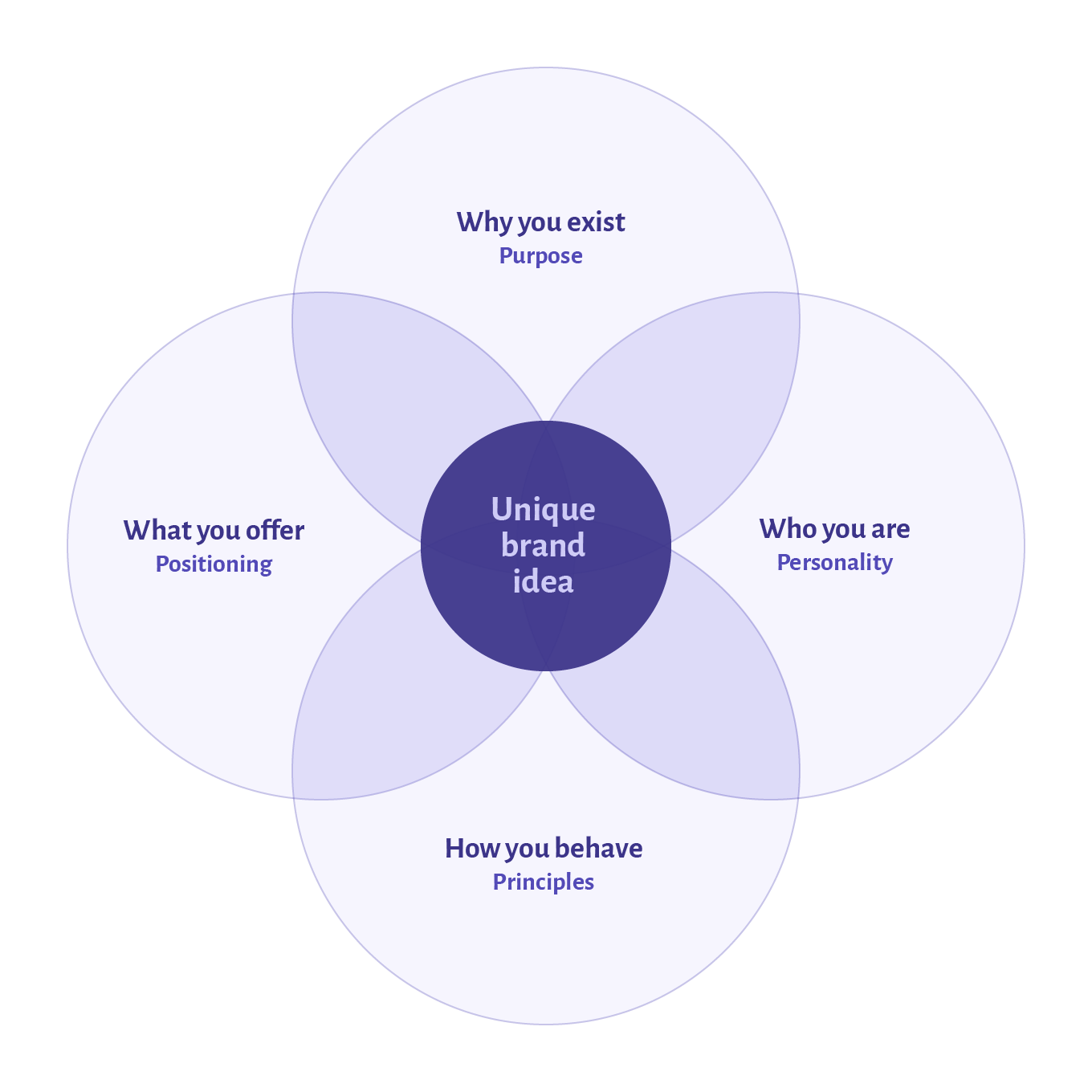
Purpose and positioning aren’t the only elements at work. Principles and personality each have their own role – shaping how the organisation behaves and how it comes across. But it’s the conflation between these two specifically – why you exist and why a customer should choose you – that creates the most downstream confusion.
Failure isn’t only conflation – treating them as the same thing. It’s also divorce – treating them as separate workstreams that never need to meet. It produces a beautifully articulated purpose with no bearing on the competitive claim, and a positioning statement that could belong to any well-run company in the sector.
The goal is distinction without disconnection.
Purpose and positioning doing different jobs, for different audiences – but each one able to point to the other and say: that’s why I exist.
One more thing worth saying. Purpose isn’t the starting point – that’s Mr Sinek’s argument, not this one. It emerges from analysis: of the market, the competition, the customers, and the organisation’s own culture. Done properly, that work surfaces purpose, positioning, principles, and personality together – distinct elements that then need a unifying idea to hold them and express them. The sequence isn’t start with why. It’s look hard at reality first, then distil what you find.
The diagnostic
So. Every organisation has a purpose. The questions worth asking are:
Has it been found and named – or is it still unexamined, shaping decisions below the surface without ever being made explicit?
Is it functional, mission-driven, or somewhere between? That determines how directly it connects to competitive positioning.
Can customers verify it through direct experience – through what you make, how you price it, how you stand behind it, how you behave when it’s inconvenient? If yes, it has earned the right to do external work. If no, it belongs internally for now.
And finally: can you trace a clear line from the purpose to what you’re claiming in the market, and back again? If the purpose can’t explain why the positioning is credible, and the positioning can’t show what the purpose means in practice – neither is doing its job.
I don’t believe Unilever’s correction was an argument against purpose. It was an argument against a specific mistake – using purpose as a substitute for competitive clarity rather than a foundation for it.
Every organisation has a purpose. The question is whether it’s been found, named, and connected to what the organisation is claiming in the market. When that line is clear – whether the purpose is functional or mission-driven – it can do competitive work, and say so. When it isn’t, no amount of declaration will make it so.
Purpose and positioning are different tools. But in any strategy worth having, they illuminate and support each other.